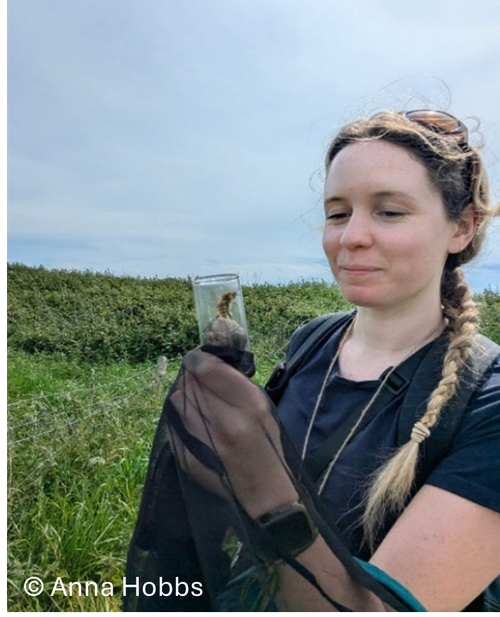
As a Natur am Byth! trainee working on the Saving the Shrill Carder Bee in Wales project, I spent most of the summer of my traineeship walking around beautiful wildflower sites in Pembrokeshire looking at bumblebees.
Alongside my line manager Anna Hobbs, we created four new BeeWalk monitoring transects in Pembrokeshire in 2025, where there have been previous records of Shrill Carder bumblebees (Bombus sylvarum). This resulted in me visiting each site once a month, walking around the Pembrokeshire coast counting bumblebees and waiting for my first encounter with a Shrill Carder.
In August, Anna and I monitored the transect on Castlemartin MOD Range for the first time. We created the transect at an area of the Range that was recommended to us by one of the Range’s long standing land management staff, who also joined us for part of the walk, sharing our enthusiasm in the Shrill Carder search.
We were told that there had been many sitings of Shrill Carder bumblebees at this site over the years, but as one of the rarest bumblebee species in Wales and in the UK, Anna and I didn’t know what to expect. It was safe to say, nothing could have prepared us for what we found.
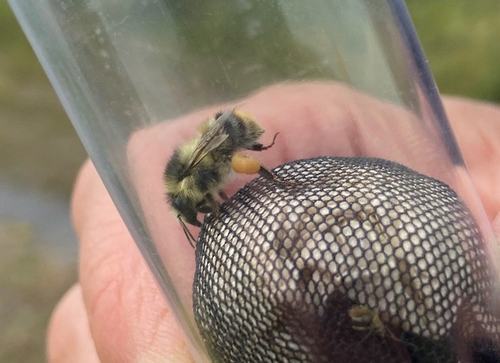
We were yet to find our first Shrill Carder in Pembrokeshire, so our ‘eye’ wasn’t quite in yet. Immediately upon walking through a dense swathe of Red Bartsia (Odontites Vernus), Knapweed (Centaurea nigra) and Sweet Melilot (Melilotus), the buzz of insects was electric. Then there it was - our first encounter with a busy Shrill Carder worker, bearing bright orange pannier-like pollen baskets.
From this first encounter there seemed to be a domino effect, with every few steps leading to another Shrill carder siting. This continued throughout the 1km transect and the common bumblebee species were for once the underrepresented groups, with heaps of Shrill Carder and Brown-banded Carder (Bombus humilis) records filling our recording form.
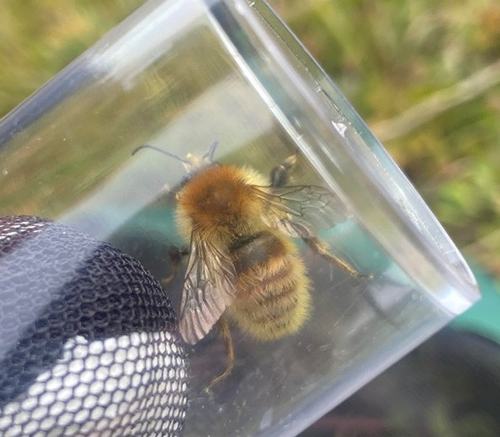
We had heard lots of stories of Castlemartin being a haven for Shrill Carders and we now have a story of our own! Our uncertainty of confidently identifying a Shrill Carder at the beginning of the walk was soon settled by the end where I think we had started to consider ourselves experts! We had even got our ‘ears in’, recognising them by their high-pitched ‘shrill’.
When we got back to the cars at the end of the day, we still couldn’t quite believe what we had experienced and questioned whether people would believe us! It felt like a milestone in my traineeship where the efforts to create the BeeWalks and monitor Shrill Carder finally came together and gave a glimpse of what a stable population of Shrill Carder in Wales could look like.