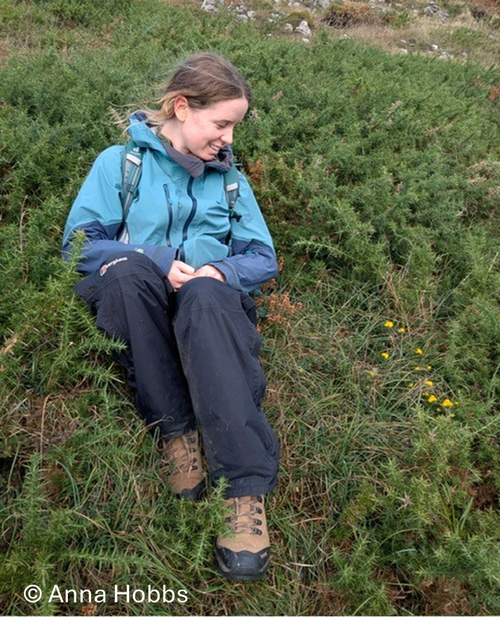
Goldilocks Aster is a Welsh native plant in the Asteraceae family, and one of the target species on the Natur am Byth! Saving the Shrill Carder Bee in Wales project. Working as a trainee on this project, I have been fortunate to visit each of the remaining populations of Goldilocks Aster in Wales, carrying out surveys and seed collections to help contribute to their conservation.
Goldilocks Aster is found on the Great Orme in North Wales, and Gower and Castlemartin in South Wales. It grows in isolated patches each threatened by competition with vigorous plant species. It is theorised that a single Goldilocks Aster plant cannot fertilise itself, and therefore, needs a Goldilocks Aster plant with different genetics to create viable seed. Both being outcompeted and lack of genetic diversity are the two biggest challenges that the remaining Welsh populations of Goldilocks Aster face.
I visited the Great Orme population in June 2025 on a Natur am Byth! habitat training day. The plants were on almost inaccessible ledges and steep slopes, where they are less threatened by being overgrazed by the Kashmiri goats that roam the Great Orme. They were also quite hard to spot without their striking bright-yellow flowers!
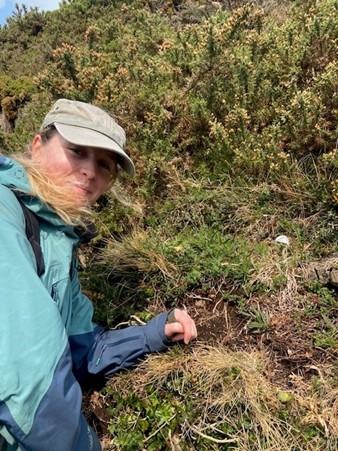
In September and October 2025, I coordinated a visit to Gower and Castlemartin, with key stakeholders of Goldilocks aster across Wales and England. We monitored each of the sub populations using past survey data, counting flowering spikes and noting associated plant communities. At Castlemartin, we even managed to collect some seed as lots of the plants had finished flowering. This seed has since undergone processing and will be stored in the National Seed bank of Wales.
Staff at the National Botanic Garden of Wales have previously completed seed collecting trips at each of the Welsh sites, with the Great Orme collection amounting to over 8000 good-quality seed in stark contrast to the sites in South Wales, with a trip to Gower resulting in 25 good-quality seed and multiple trips to Castlemartin across three years amounting to 5 good-quality seeds.
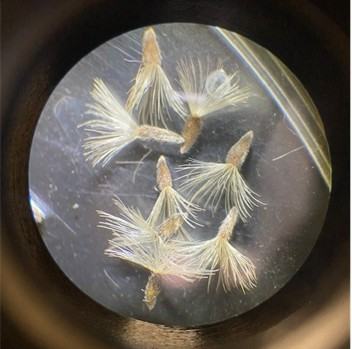
In October 2025 however, the Castlemartin seed that was collected resulted in 130 good-quality seeds after processing, a small number in comparison to Great Orme, but still a big win for the site as it was starting to be suggested that the plants there could be genetic clones.
One of my responsibilities with Goldilocks Aster in my trainee role was to complete a cross-pollination experiment between plants from Great Orme, Gower and Castlemartin. With the knowledge that we had about the number of quality seed produced at each of the sites, the aim was to understand if the plants from Gower and Castlemartin would have an increased seed set if crossed with plants from Great Orme. We also hoped to understand and provide evidence of if using plants from distant sites and presumably different genetics would boost seed set.
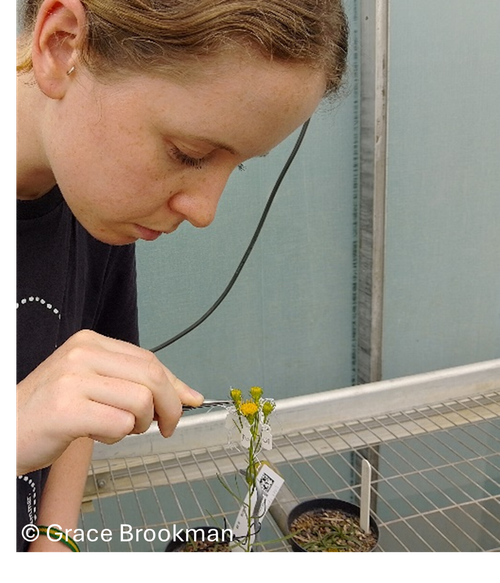
The cross-pollination experiment didn’t boost seed set and out of eight flower heads with an average of 25 flowers in each, 5 good-quality seed was found. The good-quality seed has undergone germination tests to understand the viability of the seed and resulted in one of the seeds from a Gower plant, crossed with Castlemartin pollen germinating, confirming seed viability.
Although not the results we were expecting, the experiment has provided some key baseline information on Goldilocks Aster as well as observations of flower, seed and seedling structure, which can be used by future projects and experiments in Wales and throughout the UK.
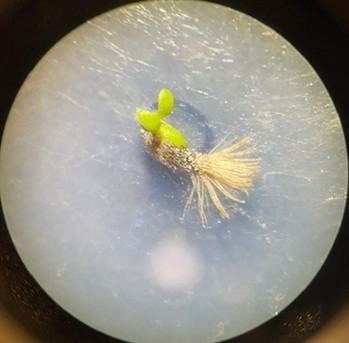
My experience of working with Goldilocks Aster and the team at the National Botanic Garden of Wales to complete the experiment has been an invaluable learning opportunity. I hope the results will inform future replicate experiments and conservation projects, helping to move closer to the goal of conserving Goldilocks Aster in Wales and across the UK.